
The Field and the Framework
Why I traded certainty for complexity

In the spirit of the solstice, many moons ago, I fell in love with biomechanics, it wasn’t because of the physics: It was because of the peace.
In order to make sense of the world science became my sanctuary. Amidst a backdrop that was often chaotic and noisy, inspection of the human body offered something of a “simple” framework. I found a profound sense of comfort in the idea that if I could just understand the levers and the force vectors, I could solve the puzzle of human suffering. It felt like I could hold on to a map as a means of wayfinding in a storm.
And in many ways, this is Yoga Philosophy 101. We stumble onto a mat seeking, either looking for, or accidentally finding answers. At a minimum to explore the questions that pop up from our subconscious every now and then. We are pacified by the rules we find there, a sequence to follow, an alignment to master, a “right” way to breathe and all will be revealed. Either deliberately or by accident we allow ourselves to be soothed by such a simple framework that promises that if we do X, then Y will follow. We think our nervous systems enjoy the certainty of the blueprint.
The Container and the System
Over the last few years as I’ve progressed through my PhD research (and so far beyond), my relationship with that “simple” framework fractured, in fact, it shattered and following diagnosis, can never be pinned back together.
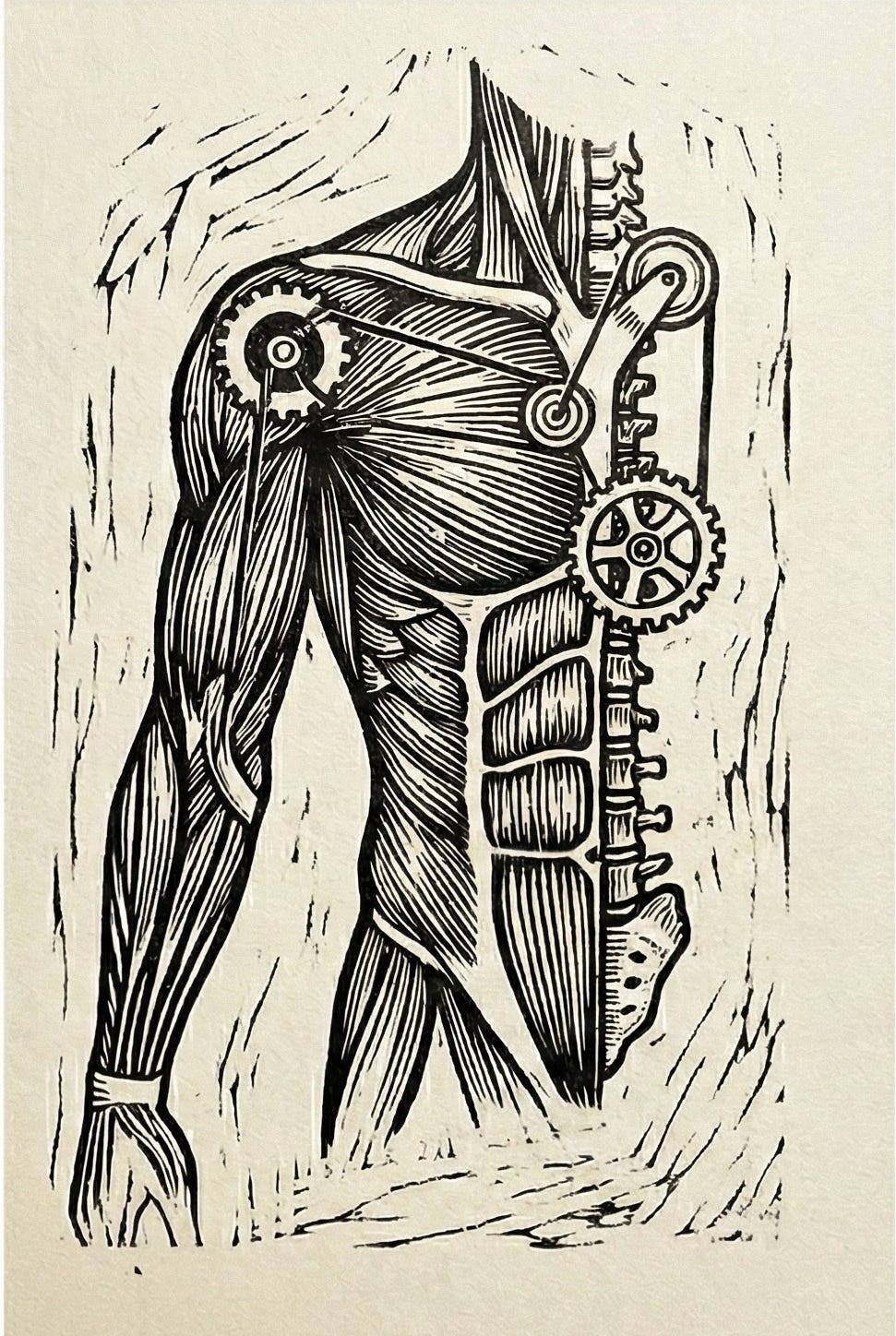
In the study of complex systems, I’ve learned something humbling: you cannot satisfactorily understand the part without looking at the system it is contained within. A gear is just a piece of metal until it is placed inside a clock; a femur is just a bone until it is part of a person walking through a gale on a windswept coast.
The framework is never the whole story. It is merely a crude sketch of the territory.
This is where yoga philosophy in the shape of the Bhagavad Gita has become an unlikely practical manual for movement. In the Gita, we are introduced to the concept of kṣetra (the field) and kṣetrajna (the knower of the field).
For years, I focused entirely on the kṣetra, the physical field of the body, the biomechanics, the “apparatus.” I thought that if I could just optimise this field, the person would be fine. My research into complex systems has taught me that the field is constantly being influenced by the “system” it lives in: the nervous system, the history of trauma, the environment, financial circumstances and the spirit of the “knower” inhabiting it (which is where I think the transformative gains of yoga reside).
From Biomechanics to Person-Centered Presence
Moving toward a person-centered approach was the moment I stopped trying to force the person to fit the framework and started looking at the system as a whole.
This has shaped my work, this evolution is reflected in how I’ve split our focus:
Strength is our study of the framework. We can use movement or asana to respect the “architecture” of the body. Hold it loosely and create a structure, like waylines on the map, that lead the nervous system to the required state (up, down, or sideways).
Resilience is our study of the system. Through practices like philosophical study, Yoga Nidra and Restorative Yoga, we may address the “knower” of the field. We work on our Saṃskāra the nervous system is approachable, giving rise to the state of mental clarity required to navigate the complexity of just being alive.
The Geometry of Being
I used to think that being a good teacher meant having all the answers, knowing exactly which muscle was “off” and how to click it back into place. Now, I realise that true science (and true yoga) is about having the courage to stay in the “unresolved moments”. Our minds, our creativity are our common apparatus of enquiry and we have no idea what they are crafted from.
It is the recognition that while biomechanics was a means of making sense of the geometry of your spine, only a person-centered approach can tell me about the weight you are carrying on your shoulders. Only intuition and experience can test the biometric hypothesis.
This Sunday, as you move or rest, I invite you to look past the “blueprint” of what you think your body should be doing. Instead, notice the system you are contained within. You are not a machine to be fixed; you are a complex, beautiful system to be understood.
I love this so much Adele. When I was in my 20s and studied Iyengar yoga, I was definitely of the mind that there is one right way to practice yoga, that there was a perfect alignment, and my goal was to achieve that. Can you tell I have suffered from perfectionism?
After 30 years of practicing, my view is more nuanced. While there are certain biomechanical concepts we need to follow, not everyone's body is the same, as you point out. Neither physically or on a nervous system level. Like anything else, one's yoga practice is nuanced too. Listening to your body is much more important. If something doesn't feel good, you don't do it, or you modify so that it does feel good. Moving your mind from black and white thinking to honoring the grey, as I like to see it, is similar to seeing the field and having an awareness of the field. It's all a practice, and an opportunity to learn something new each time you step on the mat.
What a comprehensive and fascinating post!