
What Does Yoga Really Mean?
Yoke? Union? Movements of the mind?

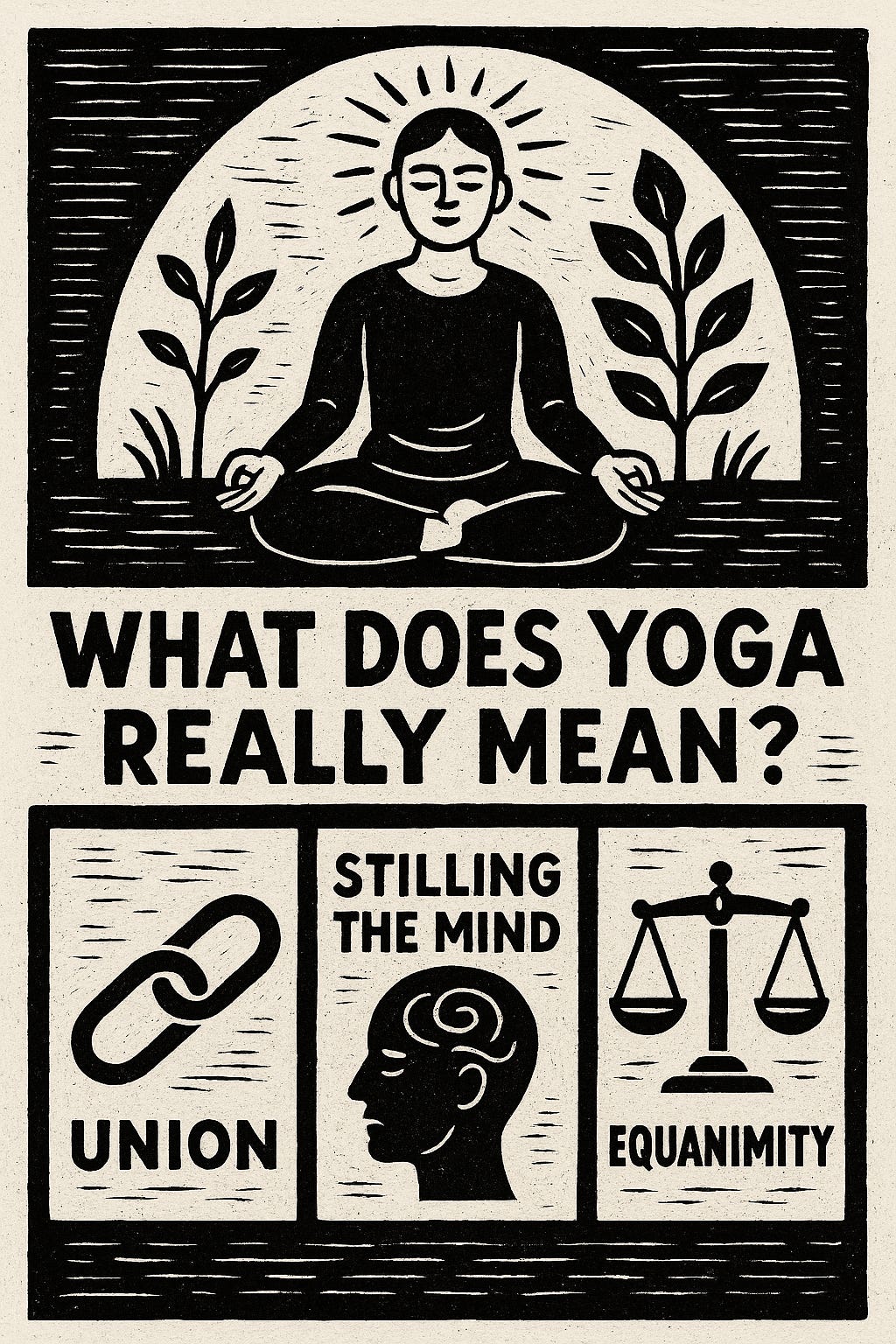
Drop into any yoga class or tune into Social media and you’ll hear many people state that yoga means: union. It’s the conventional wisdom, yoga is “yoking,” the joining together of body, mind, and spirit.
It’s a neat definition. It’s portable but it only scratches the surface of what the philosophical texts explore.
The word yoga has carried different meanings across centuries and texts, and the way we define it shapes the way we practice it. Looking a little closer shows us just how wide the field of yoga really is.
Yoga as Yoking
The root of the word yoga comes from the Sanskrit “yuj,” meaning “to yoke” or “to join.” It conjures the image of two oxen bound together under a single harness, maybe we see Kirkegard’s metaphorial yoking of horses to a runaway chariot, to help us understand the yoking of humans to suffering. In this sense, yoga is about uniting things that might otherwise pull apart, body and breath, effort and surrender, human and divine.
It’s this image that makes “union” the most common shorthand in the West and it’s not that it’s wrong. However, if we stop here, yoga risks becoming a vague metaphor for connection, when in the original texts it’s much more specific.
Patanjali: Yoga as Stilling the Mind
In the Yoga Sutra, written around 2,000 years ago, Patanjali gives perhaps the most quoted definition:
Yoga is the stilling of the fluctuations of the mind.
Here, yoga isn’t about uniting opposites, but quieting the constant whirl of thought in accordance with the impact of their effects on our overall wellbeing.
Imagine the mind as a lake. Most of the time, it’s whipped up by wind, waves of memory, anticipation, judgment. The water is too churned to see clearly. But when the wind dies down, the surface becomes still, and suddenly it reflects the world as it is. However, we must expect the wind to whip the lake up, we may cause unecessary suffering by wishing away the days until the lake is calm again.
That’s the practice of yoga according to Patanjali: not bending into shapes, but training the mind to rest in clarity. The postures, breath practices, and ethical guidelines described in later chapters are not ends in themselves but tools to help calm that restless surface. By postures, Patanjali only prescribes a comfortable seat for meditation. No splits, not downward facing dog and no handstand.
The Bhagavad Gita: Yoga as Equanimity and Action
Turn to the Bhagavad Gita and yoga takes on a different tone. Here we are not viewing the protagonist meditating in a comfortable seat. In the Gita, we are viewing the challenge of following the path of yoga through a life that must be lived.
The Gita is set on a battlefield. Arjuna, a warrior, looks out across the field of war and sees family, teachers, and friends on both sides. He is paralysed by doubt: how can he fight without betraying his values? How can he move forward when every action feels wrong?
Here Krishna, his charioteer and divine guide, steps in. His teaching is full of definitions of yoga:
Yoga is equanimity.
Yoga is skill in action.
Yoga is devotion.
In other words, yoga is not only the quieting of the mind but also the ability to act wisely in the world, even when it feels deeply unsettling. This is acceptance of the world as is.
If Patanjali’s yoga is like a calm lake, the Gita’s yoga is more like a well-trained sailor, able to hold the tiller steady even as storms crash all around.
Yoga here is not escape from difficulty but the capacity to act with steadiness, integrity, and compassion in the midst of it.
Hatha Yoga: Yoga as Force and Balance
Later traditions, like Hatha Yoga, add yet another shade of meaning. In these texts, yoga is often described as a system of physical and energetic practices designed to balance the body and awaken latent potential.
“Hatha” itself is sometimes translated as “force,” but also as the union of “ha” (sun) and “tha” (moon) (there’s this idea of yoking again) symbolic of balancing the active and receptive, the heating and cooling, the masculine and feminine aspects of ourselves. Indications of complexity, mixtures of characteristics, as opposed to polarised certainties. These reflect the afflictions which disrupt the calming of the movements of the mind, especially the impact these movements have on your ability to practice equanimity . For me, they are metaphors for understanding dualism, which often shows up in philosophy.
Here, yoga becomes more embodied: the postures, breathwork, and subtle energy practices many of us know today. A forcing of the ends of yoga, using our body as the means.
Many Facets of the Same Jewel
So which definition is “true”? Is yoga union, stillness, action, or balance?
The answer may be… All of them?
Yoga resists being trapped in a single phrase because it’s not just a concept, it’s a practice. Each text illuminates a different facet of the same jewel, catching the light in its own way.
And maybe that’s the point: yoga is too alive to be reduced to one neat sentence. It is something to be lived and experienced. However, that does not gives us as practitioners a licence to make yoga whatever we want it to be. It’s ultimate a tool for self-reflection, compassion and joining with something collectively larger than ourselves. Therefore if we are using it as a tool for division, personal gain or an extension of our ego, then we have more work to do.
A Teaching Tip
It’s easy for students to get lost in lofty definitions. One way to bring it back to the mat is to remember:
Yoga is the calming of the movements of the mind.
In terms of postures, it’s simply finding a comfortable seat.
Strip it back to this, and yoga becomes both profoundly simple and endlessly deep. It serves as a reminder that practice isn’t about chasing complexity but about returning to ease. Which is always the hardest practice of them all.
This is great. Sometimes it feels that we overcomplicate what at its core is a simple practice.