
When Yoga Gets Boundary Talk Wrong
People-pleasing, power, and why “just say no” isn’t neutral advice

There’s a popular idea circulating in wellness spaces at the moment that people-pleasing is a kind of dishonesty. That if you accommodate others too much, you’re lying. Lying to them and lying to yourself. The solution, we’re told, is to “just set boundaries” and “be authentic”.
Yoga, apparently, should help with this. However that framing only makes sense if you assume everyone has the same room to move.
Sometimes other people’s needs come before our own. Not because we don’t know ourselves, or because we lack courage, or because we’ve failed to do the inner work. It’s due to the fact we are embedded in relationships and responsibilities that don’t disappear just because we’ve had an insight.
Parents don’t opt out on hard days. Carers don’t clock off. Partners, friends, and family members don’t exist in neat, boundary-friendly compartments. Life is relational. Yoga, at its roots, has always understood this.
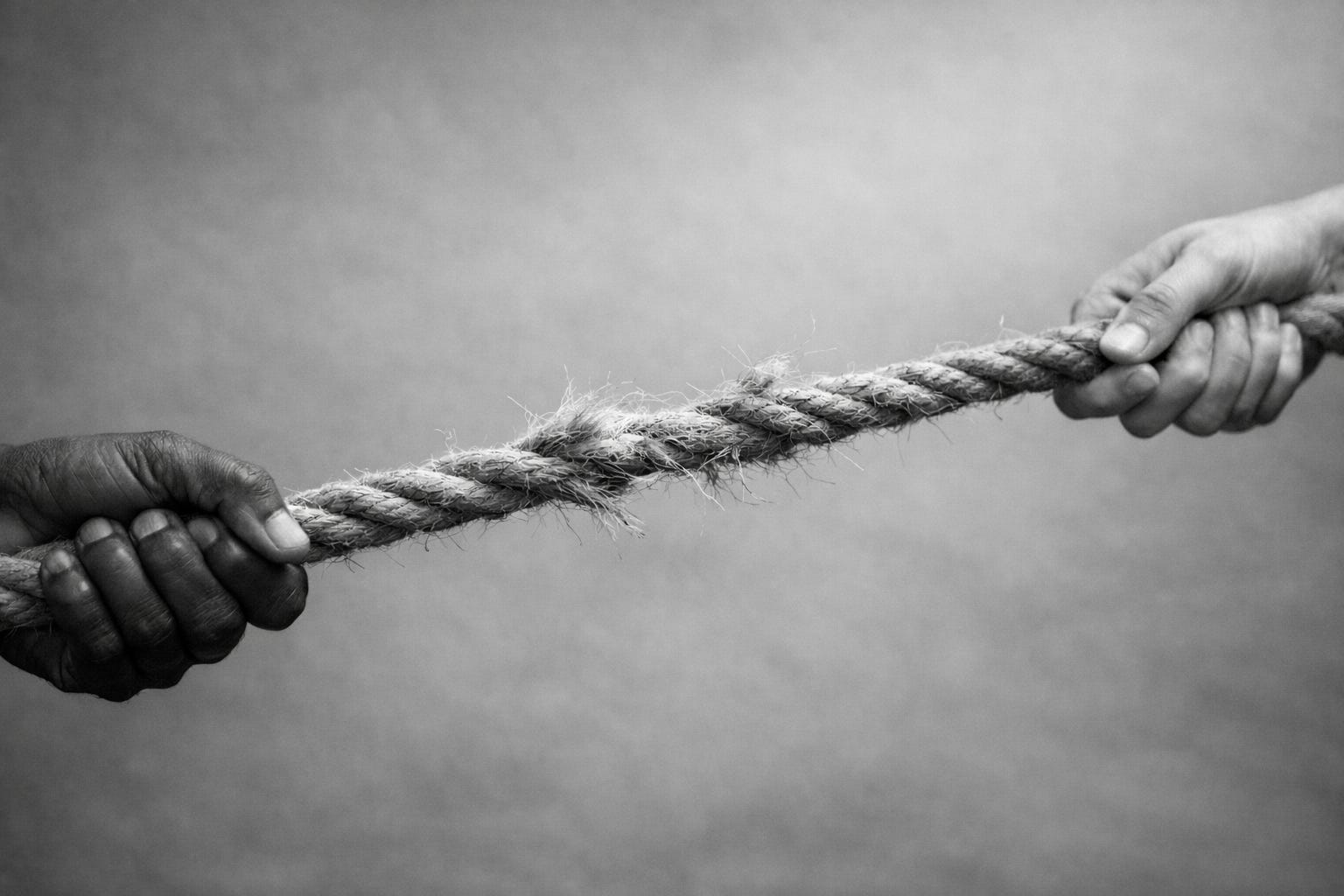
Patañjali describes practice as something that should be sthira and sukham, this means steady and easeful. My first yoga teacher often taught from this perspective. What we miss is that this is not a fixed state: it’s a relationship. What feels steady and easeful in one season of life may feel rigid or impossible in another. Balance isn’t achieved once and for all; it’s continually renegotiated in response to changing conditions.
Sometimes that renegotiation looks like swinging too far in one direction, then correcting, then overshooting again. A parent might hold firm on needing one evening alone, then feel the guilt so acutely they overcompensate by saying yes to everything for weeks. A carer might finally ask for help, only to withdraw the request when they sense even mild inconvenience in the other person's response. Someone might enforce a boundary at work, then spend months second-guessing whether they've damaged a relationship they depend on. That pendulum movement isn't failure. It's the process of learning where steadiness collapses into strain, or where softness turns into self-erasure.
Of course, this doesn’t mean we never get to prioritise our own needs. It does mean there are times when doing so comes at a real cost and pretending otherwise flattens reality. What the “people-pleasers are liars” narrative conveniently ignores is power.
Not everyone has the same freedom to say no. For some people, “just setting boundaries” isn’t a mindset shift, it’s a material risk. If you’re working multiple jobs to stay afloat, navigating racism or sexism at work, dependent on family housing, living with visa insecurity, or parenting alone without support, authenticity is not a neutral act. It’s something that can jeopardise safety, income, or belonging. In those situations, accommodating others isn’t a personal flaw. It’s the mathematics of survival.
This is where another yogic concept, viveka, aka discernment, matters. Viveka isn’t about choosing the most self-expressive option. It’s about seeing clearly what’s actually happening and responding appropriately. Sometimes discernment means recognising that saying yes now is what keeps the ground beneath you intact. That doesn’t make it unconscious or dishonest. It makes it situationally intelligent. A pragmatist.
The people most comfortable preaching radical authenticity usually have buffers: financial cushions, career flexibility, access to therapy and social capital. If a boundary backfires, there’s something underneath to absorb the shock. Many others don’t have that luxury.
Still, it’s often peripherlaised people who are labelled “people-pleasers” for doing what they must to keep a job, stay housed, protect their children, or maintain fragile support systems. Nothing really to do with a lack of insight. When this gets framed as a character issue, attention is quietly shifted away from the systems that make accommodation necessary in the first place.
This is a familiar move. It’s how neoliberal logic operates: turn structural pressure into personal failure, then offer self-improvement as the cure. You, alone, are responsible. Boundaries become another metric you’re failing. Self-care becomes another product to buy. Authenticity becomes another standard you can’t quite reach.
Yoga gets folded into this story too, stripped of context and reduced to a tool for individual optimisation. Yoga has never ignored power - for good and bad.
The Bhagavad Gita doesn’t begin with a lesson on boundary-setting. It opens on a battlefield, with duty, fear, grief, and impossible choices all present at once. Arjuna’s crisis isn’t that he doesn’t know what he wants. It’s that every option carries loss.
The text emerges from a society organised by hierarchy, where duty was determined by birth, where some people’s choices were structurally constrained by others’ power, where accommodation, or lack thereof, was built into the social order. It observes that not everyone has the same room to move.
Viveka, then, isn’t about choosing the ideal option. It’s about discernment within the conditions that actually exist, seeing clearly what’s possible and responding accordingly, because every choice contains a compromise.
Not everyone can say no to a boss, a landlord, an immigration official, or a family member they depend on. When someone working two jobs can’t “prioritise themselves” they aren’t broken. They’re navigating a system designed to extract as much as it can from them. And it’s worth saying this clearly: collective care is not people-pleasing.
In many communities, survival has never been individual. A grandmother cooking for everyone. A neighbour watching children. A friend covering a shift so someone else can rest. These are not signs of dysfunction. They are expressions of interdependence, a value yoga has always recognised, even if modern wellness culture struggles with it.
Yoga is not about becoming a perfectly bounded individual. It’s about learning how to regulate, respond, and act wisely in relationship with ourselves, with others, and with the world we actually inhabit.
Yes, boundaries matter. Absolutely. Old customs clash with new ideals and that takes courage to speak up, act differently and practice patience, balance matters too. But balance, in yoga, isn’t moral purity. It’s the ongoing practice of finding enough steadiness to stay upright and enough softness to remain human, within conditions we didn’t choose. When faced with constraints placed upon us from others.
Shaming people for survival strategies while ignoring power structures isn’t healing. It’s just individual blame dressed up in therapeutic language, a very perpetuation of the harms that divide us.
A more honest enquiry isn’t “Why can’t you set better boundaries?” It’s “What makes it unsafe for some people to set them at all?”
If yoga has something useful to offer right now, it’s not another instruction to fix ourselves. It’s a way of seeing clearly, being mindful of viveka, so we can tell the difference between where we have choice and where we are constrained.
Until conditions change, many people will continue to accommodate, adapt, soften, and stretch not because they are lying to themselves but because they are responding intelligently to the world as it is right now.
Yoga begins there: with discernment, not judgment; revealing truth.